




How Does a Polymer Flexible Anode Protect Offshore Steel Structures?
A polymer flexible anode for cathodic protection works by delivering a continuous, low-voltage protective current along the full length of a buried or submerged steel structure. The anode—shaped like a cable—sits beside the metal surface and releases current uniformly through a conductive polymer layer surrounding a copper or MMO/titanium wire core.
This electrochemical process shifts the steel's surface potential into a protective range, stopping anodic dissolution before it starts. The result is consistent corrosion suppression across every meter of pipe, tank bottom, or structural member, even in high-resistivity soils or irregular geometries where traditional anodes fall short.
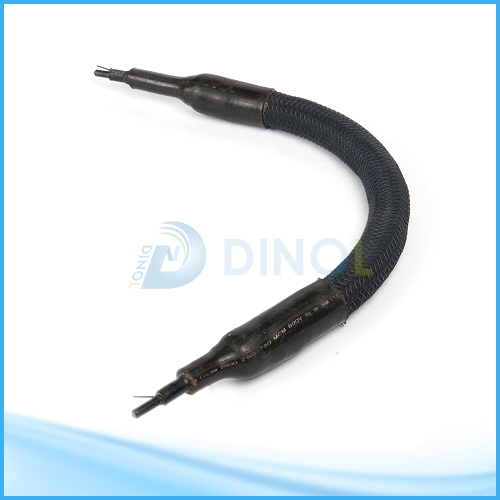
Understanding Polymer Flexible Anodes in Cathodic Protection
It's helpful to know what you're dealing with before you define any ICCP information. An impressed current anode that stays the same is not the same as a flexible linear anode. It's more like a spread current source when the flexible straight anode is used.
Material Composition
Of these, the two main types are the conductive polymer bendable anode and the MMO/Ti linear anode. The polymer type has a copper wire that is twisted and covered with a carbon-loaded polymer that has at least 99.5% carbon in it. The MMO type has a carbonaceous backfill sheath that surrounds a pure titanium wire (Ti content 99.6%, Gr1/Gr2) that is covered in a mix of metal oxides, most often iridium, ruthenium, and tantalum. Both types have an outside width of 38–40 mm and weigh about 1.5 kg/m.
How the Electrochemistry Works
The electricity moves along the low-resistance copper or titanium core and then "drips" out through the polymer or carbon layer with a high transverse resistance. This controlled flow of electricity creates an electric field that keeps everything safe. When you put coke breeze back into the trench around the anode, the ground resistance goes down and the current output goes up from about 52 mA/m to 82 mA/m in soil. ASTM D-543 tests showed that this is a real improvement.
Product Variants and Standards
Tianyi sells two kinds of MMO linear anodes: the DN-15 (φ1.5 mm Ti wire, 328 mA/m output) and the DN-30 (φ3.0 mm Ti wire, 656 mA/m output). Both are made to meet ASTM standards and are meant to last at least 40 years. You can also check them out with ISO 9001. You can pick from XLPE/PVC cables (1×10 mm²), PVDF/HMWPE cables, and EPR/CSPE cables. Each reel comes in either 500 m or 1,000 m lengths, and there is a cut-to-length service to keep on-site trash to a minimum.
Challenges in Offshore Steel Structure Protection
Offshore and buried steel structures live in one of the harshest electrochemical environments imaginable, where solutions like polymer flexible anode for cathodic protection are widely adopted. Saltwater, oxygen gradients, fluctuating temperatures, and mechanical movement all accelerate corrosion rates far beyond what coating systems alone can manage.
Why Traditional Anodes Struggle
Rigid sacrificial anodes—magnesium or zinc blocks—work well on simple geometries, but they deliver uneven current distribution across long pipeline runs or large tank floors. Discrete impressed current anodes require deep groundbeds and produce steep potential gradients, which can cause interference with adjacent structures. Neither approach handles high-resistivity soils or aging, holiday-laden coatings effectively.
Where Flexible Anodes Fit
A conductive polymer or MMO linear anode installed parallel to a pipeline eliminates the steep gradient problem. Because current discharges along the entire anode length, the protection potential decreases uniformly across the structure. Field data from pipeline rehabilitation projects in the Middle East and Southeast Asia consistently show that switching to linear anode systems reduces interference on adjacent utilities while bringing the protected structure's potential well within the –850 mV (CSE) criterion required by NACE SP0169.
ROI in Real Projects
Lower transformer-rectifier capacity requirements directly reduce capital expenditure. Uniform current distribution cuts the risk of over-protection—and the hydrogen embrittlement risk that comes with it. For tank bottom ICCP, where access for future repairs is nearly impossible, a ≥40-year design life translates into avoided excavation and remediation costs that far outweigh the initial material cost difference.
Comparative Analysis: Polymer Flexible Anode vs Traditional Anode Types
It's helpful to compare things before you buy something. How flexible linear anodes stack up against the other choices is what project engineers care about the most.
vs. Sacrificial (Galvanic) Anodes
It is simple to set up a galvanic anode, and it doesn't need any extra power. The driving voltage is set by the galvanic potential of the anode metal. It drops to ineffective levels when the soil has a resistivity of more than 5,000 ohms·cm. Polymer flexible anode for cathodic protection installed in an ICCP circuit delivers stable output current even in high-resistivity soil. Because of this, it is the suitable option for challenging soil conditions.
vs. Conventional Discrete Impressed Current Anodes
The flow of electricity is never really even along the whole length of the pipe when depth-well or remote groundbed systems are used to cover long sections of it. A lot of hotspots and zones that aren't protected happen close to the anode. This problem is solved by linear bendable anodes, which spread the anode surface over the whole structure that is being covered. The contact resistance between the MMO/Ti wire and the cord is 0.0009 Ω. This makes sure that the flow of current is always the same.
vs. Rigid MMO Tube Anodes
Rigid tube MMO anodes work well in open water, but they can't be used in small areas, like around tanks or in drains that are already full. Anode from Tianyi is bendable and can bend at least 500 mm. This lets it follow curved surfaces, corners, and uneven trench profiles, which a stiff system would not be able to do.
Installation and Technical Specifications Guide
A 40-year failure record is not the same as a 5-year protection record. This is because of how well the installation was done. Every step is important, even though the process is easy.
Pre-Installation Preparation
The outside diameter of the anode should be 39.5 ± 0.5 mm. The cable type should match the design drawings (XLPE/PVC is normal; PVDF/HMWPE is available for areas with high chemical exposure). Before accepting the delivery, make sure the joint seals are still in place. Ask for the English version of the factory test report, the Certificate of Conformance (COC), and the Technical Data Sheet (TDS) for every shipment. All three are standard documentation from Tianyi.
Step-by-Step Laying Procedure
How the installation is done is a lot like how cables are laid:
- Dig a trench parallel to the protected structure at the design offset distance.
- Spread 50% of the coke breeze backfill evenly across the trench floor.
- Lay the flexible anode on the coke bed, maintaining the specified bending radius (minimum 500 mm).
- Cover the anode with the remaining coke breeze, then compact with native soil before final backfill.
Key Technical Parameters at a Glance
| Parameter | DN-15 | DN-30 |
|---|---|---|
| MMO/Ti wire diameter | φ1.5 mm | φ3.0 mm |
| Output current | 328 mA/m | 656 mA/m |
| Contact resistance | ≤0.0009 Ω | ≤0.0009 Ω |
| Design life | ≥40 years | ≥40 years |
| Carbon content | ≥99.5% | ≥99.5% |
| Reel length | 500 m / 1,000 m | 500 m / 1,000 m |
Making the Right Choice: How to Select Polymer Flexible Anodes for Your Project
For two projects, the budget, soil condition or real-time demand are never the same. To choose the right anode setup, you have to match the specifications of polymer flexible anode for cathodic protection to site-specific project factors.
Match Output to Current Demand
Start by finding out how much current flows through your building and how resistive the ground is. Either DN-15 or DN-30 will work if your ICCP system needs outputs that are between 300 and 656 mA/m. Tianyi's engineering team can completely change the specs to fit outputs that are higher than 656 mA/m or cables that aren't the standard size. You can change the length, cross-section, and diameter of the wire to make it fit your project drawings.
Verify Supplier Quality Credentials
Batch uniformity is very important for things that will be buried in an anode. Make sure the supplier is ISO 9001 certified, follows ASTM standards, and can give you test reports from a third party that show the amount of carbon, how well the coating sticks, and how resistant it is to contact. It is possible to keep track of the steps that Tianyi takes to make their goods, such as sandblasting, pickling, and adding an exact covering to 99.6% pure titanium. You can get free samples to look over as a first draft before committing to full-project quantities.
Plan Procurement Lead Time
With standard production capacity, orders up to 10,000 m can be filled in 30 days. Every order over 10,000 m is looked at individually. Around 15 to 20 days after payment is confirmed, most shipments take place. Standard B2B overseas buying practice says that 30% of the price must be paid up front and the rest must be paid against a copy of the bill of lading.
Conclusion
Polymer flexible anode for cathodic protection and MMO linear anodes can distribute current uniformly along the full length of structures, even in high-resistivity locations or complex geometries, applicable to both offshore and buried assets — an advantage rigid anodes cannot provide. These products are ISO 9001 certified, supplied with complete English documentation, and available as cut-to-length rolls of 500 m or 1,000 m. They satisfy the technical and administrative requirements of demanding ICCP projects. Following proper standards and correct installation delivers the most cost-effective, long-term corrosion control solution.
FAQ
How long does a polymer flexible anode last in buried service?
It is planned that Tianyi's MMO linear anodes will last at least 40 years if they are used continuously in ICCP service. The amount of MMO coating used was used to get this number, which is backed up by NACE SP0169 compliance tests. This is because the coke breeze backfill lowers ground resistance and keeps chemicals from damaging the sheath. This makes the anode last longer.
Can the anode be repaired without excavation if a section fails?
It's sometimes possible to fix damaged sheaths in easy-to-reach places with splice kits. When a full mid-run failure happens, the broken part generally has to be dug up. So, before the joints are shipped, Tianyi checks to make sure they are still solid. This is an important quality check in the production process.
What certifications should I require from a polymer flexible anode supplier?
You should ask for a Certificate of Conformance, a TDS in English, and test results that meet ISO 9001 and ASTM standards for contact resistance (≤0.0009 Ω) and carbon content (≥99.5%). Verification of first-article samples by a third party adds another level of safety before full production numbers are made available.
Is a free sample available before placing a bulk order?
Yes. Tianyi gives away free samples for technical evaluation. This way, your team or the owner's corrosion engineer can do a first-article inspection and make sure that the specs meet the needs of the project before committing to 500 m or 1,000 m production reels.
Get Certified MMO Flexible Anodes from Tianyi — Request a Quote Today
Tianyi makes polymer flexible anode for cathodic protection that is ISO 9001-certified. They offer supplier-grade goods with full English paperwork, ASTM-standard tracking, and custom reel lengths from 500 m to 1,000 m. When we start making something, our expert team makes sure that the English drawings, wire diameters, and cable specs are right. To get a free sample and a detailed quote right away, email info@di-nol.com with the current needs of your project, soil resistivity data, and the length of reels you need.
References
1. NACE International. NACE SP0169: Control of External Corrosion on Underground or Submerged Metallic Piping Systems. 2013.
2. Peabody, A. W. Control of Pipeline Corrosion. 2nd ed. NACE International, 2001.
3. von Baeckmann, W., Schwenk, W., & Prinz, W. Handbook of Cathodic Corrosion Protection. 3rd ed. Gulf Professional Publishing, 1997.
4. Baeckmann, W., & Schwenk, W. "Impressed Current Cathodic Protection Using Linear Anodes." Materials Performance, 1995.
5. ASTM International. ASTM D-543: Standard Practices for Evaluating the Resistance of Plastics to Chemical Reagents. 2014.
6. Revie, R. W. (Ed.). Uhlig's Corrosion Handbook. 3rd ed. John Wiley & Sons, 2011.