




How Soil Resistivity Affects Cathodic Protection Anode Selection
Soil resistivity is one of the most decisive variables in designing an effective impressed current cathodic protection (ICCP) system. It determines how efficiently protective current travels through the ground to a buried structure. When resistivity is high, current flow becomes restricted, and conventional anodes often struggle to deliver adequate protection. A polymer flexible anode for cathodic protection addresses this challenge directly — its distributed current output and close proximity installation make it far more effective than point-source alternatives across variable soil conditions, from low-resistivity coastal clay to high-resistivity desert sand.
Understanding Soil Resistivity and Its Impact on Cathodic Protection
The amount of resistance in soil is measured in ohm-centimeters (©·cm). This shows how strongly the soil blocks the flow of electricity. As per ASTM G57, engineers usually use the Wenner four-pin method to measure it. The resistivity scale is broken down into three main groups: below 2,000 ©·cm is very corrosive, between 2,000 and 10,000 ©·cm is fairly corrosive, and above 100,000 ©·cm is high-resistivity, low-corrosion land. There are, however, under-protected zones that appear when resistivity is high. This is because high resistivity makes current distribution uneven.
How Resistivity Disrupts Current Distribution
In dry Middle Eastern and Southeast Asian project areas, high-resistance soils make current tend to gather near the anode instead of spreading out evenly along the bottom of a pipeline or tank. This creates "hot spots" of too much safety and areas of not enough protection, both of which are bad for operations. Under-protection speeds up rust, while over-protection can cause coatings to separate through cathodic shielding. Either way, hidden assets that are hard to check visually after installation will need expensive repairs.
The Measurement Gap That Costs Projects
One typical mistake in buying is choosing the type of anode and the distance between them based on the average resistivity of the soil instead of measuring how it changes along the pipeline route. Along a 10-kilometer pipeline, the soil can change a lot, from a sandy desert (>50,000 Ω·cm) to clay that has been soaked with irrigation (<1,000 Ω·cm). Even a well-designed anode system can fail in its first year of use if route-specific Wenner surveys are not done. Forpolymer flexible anode for cathodic protection, this means anode spacing and current output must be designed around actual soil resistivity variations along the route, not just a single average value.
Polymer Flexible Anodes: Innovative Solutions for Variable Soil Conditions
A linear flexible anode is easy to understand from a technical point of view: put the anode as close to the protected structure as you can and run current along the whole length instead of just from one place. This method makes soil resistivity have a lot less of an effect on current uniformity.
Composition and Working Principle
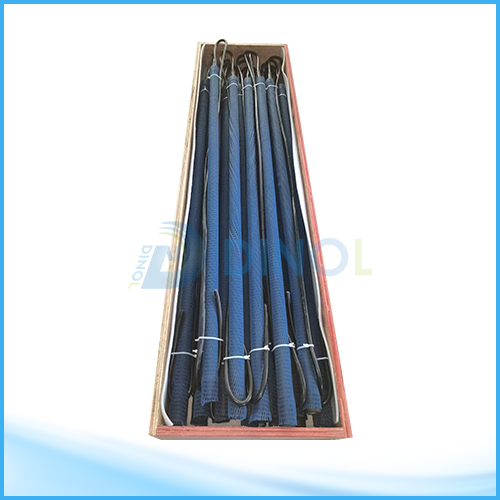
Tianyi's conductive polymer flexible anode has a stranded copper wire as the lengthwise conductor. The wire is covered in a conductive polymer layer that lets current flow slowly and evenly along its entire length. The copper core makes sure that the longitudinal resistance is low, and the polymer matrix makes sure that the transverse resistance to the soil is high. With this design, current can slowly "drip" into the solution instead of rushing in from a single source. Putting coke breeze backfill around the assembly (with a carbon content of at least 99.5%) lowers groundbed resistance even more and makes it last longer.
Some important details about Tianyi's products are:
- Output current: 300–1,000 mA/m (soil-dependent); 52 mA/m without coke backfill, 82 mA/m with coke backfill
- Outer diameter: 38–40 mm (Φ39.5 ± 0.5 mm)
- Bending radius: 500 mm minimum, enabling installation along curved tank perimeters
- Weight loss rate: <1% per ASTM D-543 chemical immersion testing
- Roll length: 500 m or 1,000 m, cut-to-length available
- Operating temperature: ≥ −18°C storage and installation minimum
These numbers show that the system works reliably in both the high-resistance desert soils of Saudi Arabia and the clay profiles that change with the amount of water in Malaysian refinery sites. Forpolymer flexible anode for cathodic protection, this kind of field validation across dramatically different soil conditions confirms that proper anode design and material selection can deliver stable performance in both arid and high-moisture environments.
If you are a procurement engineer working on tank bottom external protection or retrofitting an old pipeline, you will know that these factors directly meet the technical requirements that NACE/AMPP-compliant owner engineers put on material clearance lists. Each package comes with an independent test report and an ISO 9001 certification, which help the material review board's approval process.
Comparing Polymer Flexible Anodes with Traditional and Alternative Anodes
Knowing when polymer flexible wire anodes work better than other options helps procurement managers make a strong case for the choice that can be reviewed by the owner engineer.
In low-resistance, uniform soils, traditional high-silicon cast iron or graphite point anodes work fine. Their point-source output makes steep potential gradients, which is a problem in places with a lot of resistivity or a lot of different shapes. Zinc ribbon anodes can be used as a substitute, but they have a very low resistivity. In fact, NACE SP0169 says that zinc sacrificial anodes shouldn't be used in soils with a resistance higher than about 1,500 ©·cm because they could passivate.
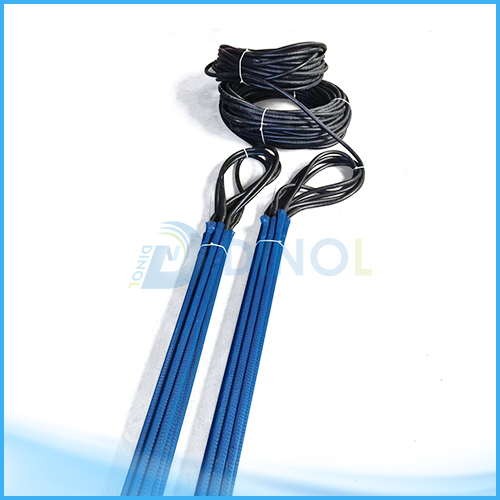
One type of flexible anode that works better than the others is MMO/Ti linear anodes. The DN-15 model from Tianyi uses φ1.5 mm MMO/Ti wire and can output 328 mA/m. The DN-30 model uses φ3.0 mm wire and can output 656 mA/m. Both models are designed to last more than 40 years. The titanium substrate is 99.6% pure and was made by sandblasting, pickling, and applying a precision coating in accordance with ASTM standards. The contact resistance between the MMO/Ti wire and the 1×10 mm² XLPE/PVC cable inside is 0.0009 Ω, which directly supports even potential distribution along structures that are protected.
When you look at the total cost of ownership over 40 years, the higher initial cost of MMO linear anodes compared to cast iron quickly disappears when you consider the costs of not having to dig up and replace the asset. This math is easy to understand for projects in the Middle East that have tight schedules and high costs for movement.
Installation and Maintenance Considerations for Polymer Flexible Anodes
A well-specified anode can only be used as a safety device if it is installed correctly. For Tianyi's MMO linear anode, the installation process follows a cable-laying logic that most field crews can do quickly:
Make a trench that runs parallel to the pipeline or all the way around the tank. Place about half of the coke breeze bed on the ground, then place the flexible anode on top. Cover with the rest of the coke breeze, pack it down with native soil, and fill in all the way around. The anode's minimum bending radius of 500 mm lets it bend in different directions without putting mechanical stress on the MMO/Ti wire-to-cable joint. This is the most likely place for failure in any linear anode system because it is sealed with materials that don't rust or age. Forpolymer flexible anode for cathodic protection, following this installation sequence and respecting the bending radius is what protects the critical wire-to-cable connection and ensures the system performs reliably over decades of service.
Regular maintenance includes checking the output of the rectifier and doing close-interval potential studies (CIPS) on a regular basis. Based on the fact that buried flexible anodes can't be seen, baseline electrical readings taken during commissioning are used to measure performance drift. Titanyi includes English-language technical data sheets (TDS), certificates of conformance (COC), and factory test results with every order. These are the kinds of papers that owner engineers and third-party testers need to keep checking for compliance.
Procurement and Supplier Insights for Polymer Flexible Anodes
It takes more than just comparing prices to find a trusted polymer flexible anode maker. When purchasing managers look at suppliers, they should make sure that they have ISO 9001 certification, testing records that follow ASTM standards, and proof that they can make consistent batches across 500 m and 1,000 m reel lengths. The main technical risk of buying a buried anode is that the carbon content or contact resistance may vary from batch to batch. This is something that can be fixed by having a third party inspect the anode when the supplier's quality systems aren't yet established through repeat orders.
Tianyi is based in the Baoji High-Tech Development Zone and makes MMO-coated titanium anodes. They can do both OEM and ODM work. Standard lead time for stocked configurations is 15–20 days. Custom specifications, such as wire diameter (φ1.0, φ1.5, φ3.0 mm), cable type (XLPE/PVC, PVDF/HMWPE, EPR/CSPE), and reel length, take about 30 days. Terms of payment work with both L/C and T/T arrangements. Before committing to a large order, free samples can be used for technical testing. This directly meets the need for a first-article check that is common in owner-engineer-approved vendor programs. There are set rounds for customers in North America, Saudi Arabia, the UAE, Malaysia, and Indonesia to buy from Tianyi again and again.
Conclusion
The resistivity of the soil is not a background variable; it is the main design factor that determines the anode type, spacing, and current generation needs of any ICCP project. Linear flexible anodes, especially MMO/Ti versions, solve the current distribution problems that point-source anodes can't handle in areas with high or changing resistance. Tianyi's flexible anode product line is a technically sound and cost-effective way to protect tanks and pipelines around the world. It has a design life of more than 40 years, ASTM test data that can be checked, and specs that can be changed to fit any needs. Forpolymer flexible anode for cathodic protection, this combination of soil-responsive design, long service life and verifiable performance data makes it a reliable choice for demanding ICCP applications.
FAQ
Does higher soil resistivity shorten anode service life?
Not all the time. The rate of the electrochemical reaction at the anode surface slows down when the earth has a higher resistance. This can actually slow down usage. It's more likely that the protected structure won't get enough power in high-resistance settings than that the anode will wear out faster.
Can a polymer flexible anode perform in chemically aggressive soils?
Yes. Both the conductive polymer sheath and the MMO/Ti coating don't change when the pH level changes. Titanyi has a weight loss rate of less than 1% per ASTM D-543, which shows that it can withstand the harsh chemical conditions that are common in petrochemical and refinery soils.
What certifications should I require from a supplier?
Need to be certified by ISO 9001, have factory test reports that meet ASTM standards, and a certificate of conformance (COC) that lists the carbon content (≥99.5%), contact resistance (≤0.0009 Ω), and current output per reel. For first sales, it is best to have a third party check the factory.
Are custom reel lengths and cable specifications available?
Tianyi lets you change the thickness of the MMO/Ti wire, the type of insulation on the cable, the length of the reel, and the output current rate. Before production starts, specification sheets can be checked with the technical team in English.
Get a Customized Polymer Flexible Anode Quote from Tianyi
For your next tank or pipeline job, you should use an ICCP anode system that is perfectly matched to the resistivity curve of your soil. Tianyi is a known provider of ISO 9001-certified polymer flexible anodes for cathodic protection. They offer OEM services, 500 m and 1,000 m reel choices, and full English paperwork. Get your free sample or quote for your specific project right now. To see the full range of products, email our expert team at info@di-nol.com.
References
1.NACE International. Corrosion Control of Underground Storage Tank Systems by Cathodic Protection (SP0285). NACE International, 2011.
2.Peabody, A. W. Control of Pipeline Corrosion. 2nd ed. NACE International, 2001.
3.ASTM International. Standard Test Method for Field Measurement of Soil Resistivity Using the Wenner Four-Electrode Method (ASTM G57). ASTM International, 2012.
4.Baeckmann, W. von, Schwenk, W., and Prinz, W. Handbook of Cathodic Corrosion Protection. 3rd ed. Gulf Professional Publishing, 1997.
5.Shreir, L. L., Jarman, R. A., and Burstein, G. T. Corrosion: Corrosion Control. Vol. 2. Butterworth-Heinemann, 1994.
6.AMPP (formerly NACE). Cathodic Protection of Aboveground Petroleum Storage Tanks (SP0193). AMPP, 2016.