




MMO/Ti Anode Benefits for Long-Term Cathodic Protection Systems
When infrastructure operators ask me which anode technology delivers the most dependable corrosion control over decades, my answer is consistent: the MMO/Ti linear anode for cathodic protection. Built on a Grade 1/2 titanium substrate coated with Mixed Metal Oxides (typically iridium, ruthenium, and tantalum), this anode delivers a continuous, linear current field across buried pipelines, tank bottoms, and complex piping networks. With a consumption rate as low as 1–6 mg/A-yr and a rated service life exceeding 40 years, it outperforms graphite and zinc alternatives in nearly every demanding field condition.
Understanding MMO/Ti Linear Anodes and Their Role in Cathodic Protection
What Is an MMO/Ti Linear Anode?
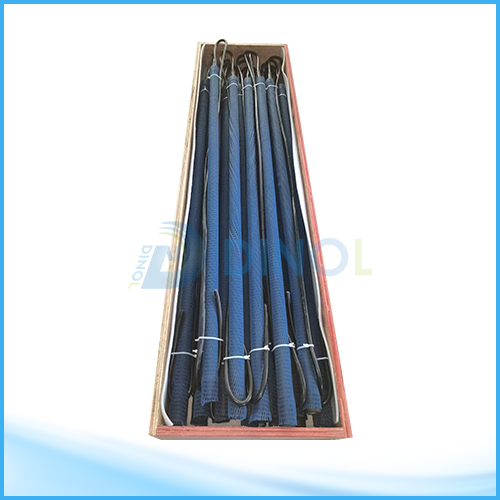
As part of impressed current cathodic protection (ICCP), an MMO/Ti linear anode is a flexible titanium wire covered in catalytic Mixed Metal Oxides. It comes pre-packaged in conductive carbonaceous backfill inside a porous fabric sleeve. The line sends electricity, and the MMO/Ti wire lets go of the protected electric field into the ground. This straight line shape gets rid of the "shielding" gaps that regular point anodes leave behind in places with a lot of resistance or congestion.
How It Works Electrochemically?
Current flows from the power source to the anode, then into the ground and into the protected pipeline. This makes the surface of the pipeline cathodic. When the pipeline is connected to the negative terminal, it stays in an environment that lowers the charge, which stops electrochemical corrosion. The MMO coating is very good at breaking down oxygen and chlorine, which helps keep the titanium substrate stable. The coating itself wears off very slowly, usually less than 6 mg/A-yr.
Why the Titanium Substrate Matters?
Tianyi's MMO/Ti linear anode for cathodic protection wire is made of titanium that is 99.6% pure and has been treated by sandblasting, pickling, and applying a precise covering. About 0.000056 ohm-cm of resistance can be found in the material. This very low resistance, along with a smooth surface finish and production that meets ASTM standards, guaranties uniformity from batch to batch. This is very important for integrators who stock standard reels and can't afford for performance to change in the middle of a project.
Key Performance and Installation Considerations for Long-Term Success
Step-by-Step Installation in the Field
A flexible linear anode is put in place in a way that is similar to how cables are laid. Make a trench next to the pipeline and spread out half of the coke breeze. Then, put the anode in the trench and cover it with the other half of the coke breeze. Pack down the anode with native soil and finish the backfilling. The coke backfill lowers the resistance to grounding and stops titanium from making an oxide layer that isn't conductive. At splice points, resin-filled T-joints or inline kits are used to keep the electrical and environmental integrity.
Maintaining Consistent Output Over Decades
Readings of the cathodic protection potential should be compared to the –850 mV (CSE) standard set out in NACE SP0169 as part of regular tracking. For long runs, power feed points every 100–300 m make up for the fact that the voltage drops along the copper core. There must be no more than 0.0009 Ω of contact resistance between the MMO/Ti wire and the header cable. The DN-15 model (φ1.5 mm wire) outputs 328 mA/m and the DN-30 model (φ3.0 mm wire) outputs 656 mA/m. These fixed values make it easy to match rectifier capacity to project load.
Applications That Prove Long-Term Reliability
Here are the main situations in the field where linear anode systems clearly work better:
- Aging pipelines with deteriorated coatings — The uniform current profile compensates for coating holidays without overprotecting adjacent sections.
- Aboveground storage tank (AST) bottoms — A grid or spiral layout in the space between the tank floor and secondary liner provides coverage in under 1 meter of clearance.
- Urban utility corridors — Linear proximity targeting avoids stray-current interference with adjacent buried structures that deep-well groundbeds cannot prevent.
- High-resistivity soil regions — The pre-packaged conductive backfill (carbon content ≥ 99.5%) maintains a stable low-resistance path even in sandy or rocky ground.
- Aboveground storage tank (AST) bottoms — The space between the tank floor and secondary liner can be covered with a grid or spiral pattern that takes up less than 1 meter of space.
Comparing MMO/Ti Linear Anodes with Alternative Solutions
MMO/Ti vs. Graphite and Zinc
Graphite anodes wear out quickly and can break under mechanical stress. Zinc substitute anodes wear out quickly and stop working well in dirt with a high resistance. The MMO/Ti linear anode for cathodic protection has a design life of 40 years, which neither of the other options gets under normal working conditions. For installers in charge of long-distance pipeline projects in Eastern Europe, South America, or the Middle East, where digging costs are high, the MMO/Ti system's lower replacement frequency lowers total lifetime costs by a large amount.
MMO/Ti vs. Platinum-Coated Alternatives
Platinum-coated titanium anodes work well in salt water, but they cost more to make, which makes it harder to sell them again. Using iridium-tantalum coatings on MMO/Ti anodes (6–10 μm thick), they can work at temperatures up to 80°C and current levels below 2,000 A/m². They can also handle the same seawater and buried-structure uses at a lower cost. Integrators can keep the 30% to 40% resale margins they need to stay in business thanks to this cost gap.
Lifecycle Cost and Supplier Differentiation
Verified ISO 9001 certification, production that meets ASTM standards, and documented accelerated life testing (NACE TM0108) are what set trustworthy manufacturers apart from generic suppliers. For items that have been buried for forty years, quality control checks like bending adhesion tests, XRF coating loading analysis, and electrical continuity checks must be done. Buyers who don't do these checks run the risk of failures in the field, where it's hard to figure out who is responsible for failure analysis. Structured supplier qualification directly fixes this problem.
Procurement Guide and Supplier Insights for Global B2B Buyers
Pricing, MOQ, and Order Flexibility
The MMO/Ti linear anodes that Tianyi sells come in standard 500 m and 1,000 m reels with the model numbers DN-15 and DN-30. The wire diameters range from φ1.0 mm to φ3.0 mm, and the outer diameter is 39.5 ± 0.5 mm. Small developers whose yearly anode budgets are between $50,000 and $500,000 can order either partial reels or full containers, based on the progress of their projects. With tiered volume pricing and annual framework agreements, buyers can lock in prices even if the value of the currency changes, which is a real concern for businesses in Turkey, Argentina, and Brazil.
OEM White-Label and Custom Design Support
This is the list of OEM and customization choices. Tianyi offers resale-focused developers the following:
- Neutral or branded packaging — Products can ship under your company label with no Tianyi markings, ready for local resale.
- Custom wire diameter and cable type — XLPE/PVC, PVDF/HMWPE, and EPR/CSPE cables are available; internal copper core size is configurable.
- Cut-to-length reels — Standard 500 m and 1,000 m reels, or project-specific lengths negotiated directly.
- Free samples — Available for electrochemical accelerated life testing before committing to a trial order.
These choices give integrators the supply chain flexibility to meet the needs of both restocking and custom projects without having to keep extra inventory.
Logistics and Export Documentation
For MMO/Ti linear anode for cathodic protection orders under 10,000 m, standard delivery takes 15–20 days after payment confirmation. For larger orders, delivery times are negotiated individually. The packaging for export meets international shipping standards, and all the paperwork needed to get through customs is included, such as certificates of origin and inspection reports. Early-order scheduling under a framework agreement keeps project schedules on track in places where clearing the port takes 4 to 8 weeks.
Future Trends and Environmental Impact of MMO/Ti Linear Anodes
Reduced Waste and Longer Asset Life
When compared to zinc or graphite systems that need to be replaced every 40 years, systems with a service life of more than 40 years mean less waste and fewer replacements. If procurement teams are adding ESG reporting to their supplier scorecards, finding anodes that have been shown to last a long time and be used in small amounts can help with sustainability audits.
Advances in Coating Technology
As the thermal decomposition coating processes get better, the active life of the catalytic layer is extended while the amount of precious metal loaded decreases. Tighter quality control in XRF verification and ultrasonic flaw detection during production means that coating consistency across batches keeps getting better. This directly lowers the batch-variation risk that integrators have historically used as an excuse not to switch suppliers.
Strategic Value for B2B Buyers
When you buy from a qualified MMO/Ti linear anode supplier, you can use the same buying process over and over again. The supplier should offer standard specifications for stock, flexible specifications for projects, OEM packaging for resale, and documented test data to give end clients confidence. This structure supports margin protection even when currencies are changing hands a lot.
Conclusion
MMO/Ti linear anode for cathodic protection deliver measurable advantages in service life, current distribution uniformity, and total lifecycle cost when compared to graphite, zinc, or conventional impressed current alternatives. With a titanium purity of 99.6%, ISO 9001 certification, ASTM-compliant production, and output options from 328 mA/m to 656 mA/m, Tianyi's product line covers the full range of pipeline, storage tank, and marine ICCP applications. For integrators who need both standard stock and custom-engineered solutions backed by verifiable quality data, this technology represents a sound long-term procurement commitment.
FAQ
How long do MMO/Ti linear anodes typically last in buried applications?
Under standard operating conditions—current density below 2,000 A/m² and soil temperature below 80°C—the expected service life is 40 years or more. This assumes correct coke breeze backfill installation and periodic potential monitoring.
What wire diameters are available, and how does diameter affect output?
Tianyi offers φ1.0 mm, φ1.5 mm, φ2.0 mm, and φ3.0 mm MMO/Ti wire diameters. The DN-15 (φ1.5 mm) outputs 328 mA/m; the DN-30 (φ3.0 mm) outputs 656 mA/m.
Can these anodes be used in seawater environments?
Yes. For seawater and offshore platform jacket applications, the MMO coating formulation shifts toward chlorine evolution chemistry. The iridium-tantalum coating handles saline electrolytes effectively, and the product outer diameter of 38–40 mm accommodates standard marine installation hardware.
How does field splicing work?
Field splices use resin-filled T-joints or inline connection kits that maintain environmental sealing and electrical continuity. Contact resistance at the MMO/Ti wire-to-cable junction stays at or below 0.0009 Ω, which is verified during production quality control.
Is OEM white-label packaging available for resale?
Yes. Tianyi supports neutral packaging or custom branded packaging for integrators who resell under their own product line. This service is available alongside standard or custom anode specifications.
Partner with Tianyi for Your Next MMO/Ti Linear Anode for Cathodic Protection Project
Tianyi, based in Baoji's High-Tech Development Zone, supplies ISO 9001-certified MMO/Ti linear anode for cathodic protection to integrators across North America, Europe, South America, the Middle East, and beyond. Our production covers standard DN-15/DN-30 reels and fully engineered custom specifications. Free samples are available for qualification testing. Contact our team at info@di-nol.comto request a tiered pricing table and OEM packaging quote today. As a direct MMO/Ti linear anode for cathodic protection manufacturer, we support trial orders and annual framework agreements.
References
1.Britz, D. & Strutwolf, J. — Digital Simulation in Electrochemistry, Springer, 2016.
2.NACE International — NACE SP0169: Control of External Corrosion on Underground or Submerged Metallic Piping Systems, NACE International, 2013.
3.Peabody, A. W. — Peabody's Control of Pipeline Corrosion, 2nd ed., NACE International, 2001.
4.Lide, D. R. (ed.) — CRC Handbook of Chemistry and Physics, 95th ed., CRC Press, 2014.
5.Gabe, D. R. — "The role of hydrogen in metal electrodeposition," Journal of Applied Electrochemistry, Vol. 27, 1997.
6.ASTM International — ASTM G8: Standard Test Methods for Cathodic Disbonding of Pipeline Coatings, ASTM International, 2016.
