




Top 5 MMO Titanium Canister Anode Uses in Offshore Systems
Offshore corrosion prevention workers know seawater damages metal structures quickly. MMO titanium canister anode for cathodic protection for impressed current cathodic protection (ICCP) systems are the preferred choice in maritime and offshore situations. Factory-prepackaged assemblies on an ASTM B338 Grade 1 titanium substrate covered with noble metal oxides like Ru-Ir, Ir-Ta, or platinum provide steady protective current for 20 to 70 years, outlasting ferrosilicon or graphite anodes. I will explain the top five offshore applications where this technology adds the greatest value in this article.
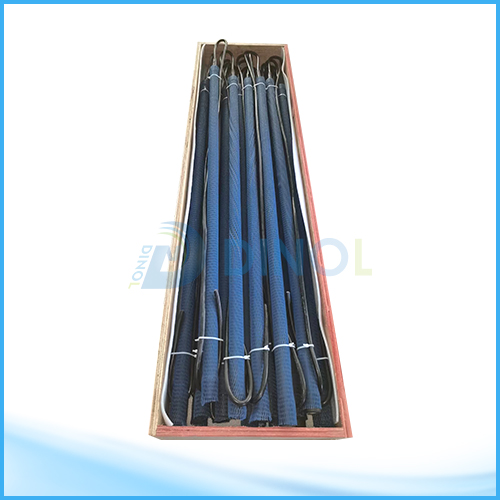
MMO Titanium Canister Anode for Offshore Platform Cathodic Protection
Why Offshore Platforms Need Dedicated ICCP Solutions
Seawater with a lot of chlorine is always attacking steel jacket structures on offshore platforms with electrochemical attacks. NACE International says that corrosion costs the oil and gas industry more than $1.37 billion a year just in platform maintenance. It's not enough to have an inactive coating system; platforms need active defense based on current.
How These Anodes Work in This Environment
The MMO titanium canister anode gives off a steady DC current, usually between 5 A and 50 A per unit, which lowers the steel's potential below the safety level of -850 mV (CSE), which is what NACE SP0176 says should happen. The titanium base doesn't rust in electrolytes with a pH of 1 to 12, and the MMO coating keeps usage below 1 mg/Amp-year, which was proven by NACE TM0108 accelerated life tests.
Operational Longevity vs. Traditional Anodes
In the Gulf of Mexico, a platform operator changed their high-silicon cast iron groundbed with MMO titanium tube anodes (80 × 1000 mm, ASTM B338 Gr.1). They saw a 40% drop in rectifier power draw and no need to replace the anodes for 12 years. That's the kind of information procurement engineers need to show a project steering committee why a different material should be used instead of the original.
MMO Titanium Canister Anodes in Subsea Pipeline Protection
The Corrosion Challenge Subsea Pipelines Face
Undersea pipes move oil and gas through places with changing temperatures, high pressure, and lots of microbes that break down metal quickly. MMO titanium canister anode for cathodic protection provides reliable corrosion protection for these pipelines. According to the U.S. Pipeline and Hazardous Materials Safety Administration (PHMSA), external corrosion is still one of the main reasons why pipeline accidents happen.
MMO vs. Zinc and Magnesium Sacrificial Anodes
This is a direct comparison that lifetime cost experts care about:
- MMO titanium anodes carry a design life of 30–50 years at standard current densities, require no replacement once installed, and maintain constant current output regardless of soil resistivity changes.
- Zinc anodes are limited to seawater or low-resistivity environments and deplete over 5–10 years, creating recurring replacement costs.
- Magnesium anodes work in higher-resistivity soil but consume rapidly and generate hydrogen, which can be hazardous in enclosed structures.
These are not small differences. According to studies published in the Materials Performance journal, moving from sacrificial to MMO-based ICCP can cut total anode-related costs by 30–50% over the course of a 30-year pipeline tenure.
Installation Considerations for Deep-Well Groundbeds
For urban pipeline crossings with a lot of traffic or high-resistance soil zones, installing the anode in a deep well deeper than 20 meters puts it far away from the protected building. This shape makes the current flow more evenly and lowers the amount of stray current that interferes with nearby utilities, which is a requirement that is directly stated in ISO 15589-1.
MMO Titanium Canister Anodes in Offshore Storage Tank Protection
Tank Bottom Corrosion Is a Hidden Liability
Above-ground storage tanks (ASTs) at marine terminals are built on foundations that are buried in the ground. This means that water, chloride, and differential aeration cells can cause corrosion to build up at the base of the tank. MMO titanium canister anode for cathodic protection is used for tank bottom corrosion control. Cathodic protection for tank bottoms is required by API 651 and regulators are asking for documented ICCP systems as part of tank inspection records more and more.
How Factory-Prepackaged Canister Anodes Simplify Installation
The anode string, gas vent pipe, calcined petroleum coke backfill, and galvanized steel casing are all factory-assembled in Tianyi's prefabricated MMO canister assemblies, so they are ready to use. By moving the electrochemical reaction away from the titanium element itself, the backfill lowers the groundbed resistance and protects the structural life of the anode. Installers only need to lower the unit into a well that has already been drilled, connect the PVDF or HMWPE cable, and turn on the rectifier.
Putting this premade plan together is easier because of the following:
- Pre-compacted petroleum coke backfill eliminates on-site guesswork about compaction density.
- The gas vent pipe prevents oxygen and CO₂ from blocking the anode reaction zone.
- IP68-rated cable joints with epoxy resin encapsulation and heat-shrink tubing prevent moisture ingress at the most common failure point.
When a contractor does hidden work, their biggest fear is that the connection will break years after the backfill is done. These features directly address that fear.
MMO Titanium Canister Anodes in Offshore Mooring Systems
Mooring Hardware Corrosion Is a Safety Issue
Anchor frames, mooring bands, and bolts are all load-bearing parts. Corrosion in weld zones or cracks lowers the cross-sectional area and can lead to severe stress failure. Classification societies, like DNV and ABS, need mooring systems on mobile production units to have recorded corrosion protection plans.
Targeted ICCP for Mooring Attachment Points
When MMO titanium canister anode for cathodic protection are placed near chain lockers, fairleads, and anchor pockets, they send current to exactly the places where geometry makes it hard for passive coatings to stick. The ASTM B338 Grade 1 material used to make the titanium substrate is very strong mechanically, so it can handle the vibration loads that are common in dynamic mooring environments without changing size.
Supplier Qualification and Standards Compliance
Our products are made to meet the requirements of EN 12954, NACE SP0176, and GB/T 50934 for procurement teams that are starting the supplier qualification process. Each batch comes with a Certificate of Conformance (CoC), XRF test results for coating loads, and records of electrical continuity tests for every cable-to-anode link. These papers help the design institute get approval and make sure that workers follow the owner's engineer's instructions without having to go through multiple rounds of explanation.
MMO Titanium Canister Anode Applications in Offshore Renewables
Wind Turbine Foundations Demand Long-Term Protection
The tidal and splash zone is where the monopile and jacket supports for offshore wind turbines are located. This is the most corrosion-prone area for any maritime construction. The Global Wind Energy Council thinks that offshore wind capacity will be higher than 380 GW by 2032. This means that steel foundations worth billions of dollars will need to be protected from corrosion for 25 to 30 years.
Lifecycle Cost Advantage for Renewable Developers
Total cost of ownership is the most important factor for wind farm developers and their EPC contractors. An MMO titanium anode system with a 30–50-year service life that meets EN 12954 and ISO 15589-2 standards gets rid of the need for mid-life anode changes that would involve dives, moving the vessel, and stopping production.
Coating Options and Energy Efficiency
Our Ir-Ta and Ru-Ir coated anodes (8–15 g of noble metal loading) keep the overpotential low at working current levels. This means that the rectifier needs less power to keep the necessary safe potential. Over the life of a 25-year turbine, that energy savings can be measured at the asset level. This is a valid point that fits with policies that focus on sustainable buying.
Conclusion
MMO titanium canister anode for cathodic protection regularly beats standard anode materials in terms of total cost, service life, and current stability. It can be used in storage tanks, mooring systems, and the bases of wind turbines. The factory-prepackaged design takes away the need for construction variables during the groundbed installation process.
Compliance with ASTM B338, EN 12954, and NACE SP0176 gives procurement teams the proof they need to pass technical review. This technology should be part of your material specification for your next project that involves buried or submerged steel structures that need long-term electrochemical protection.
FAQ
What determines the service life of an MMO titanium canister anode?
Service life depends primarily on MMO coating thickness (8–15 g noble metal loading) and the applied current density. At 100 A/m², a well-designed anode system achieves 20+ years, and our premium configurations are rated for 30–50 years.
Why is carbonaceous backfill included inside the canister?
Calcined petroleum coke backfill lowers the anode-to-earth resistance, extends the effective reaction surface, and provides a pathway for evolved oxygen and CO₂ to escape — preventing gas blocking that would otherwise raise circuit resistance.
How is the cable-to-anode connection sealed?
We apply a multi-stage process: epoxy resin encapsulation followed by heat-shrink tubing, achieving IP68 waterproof rating. This is the most common failure point in buried ICCP systems, and our sealing method is verified through electrical continuity testing before shipment.
Which cable insulation should I specify?
HMWPE or PVDF insulation is standard for MMO titanium canister anode cables. Both materials resist chlorine gas and oxidizing environments generated at the anode surface.
Do you supply standard compliance documents?
Yes. We provide EN 12954, NACE SP0176, and GB/T 50934 specification alignment documents, along with XRF coating verification reports and a Certificate of Conformance for every shipment.
Partner with Tianyi — Your Trusted MMO Titanium Canister Anode Supplier
At our Baoji facility, Tianyi makes ASTM B338 Grade 1 titanium anodes with Ru-Ir, Ir-Ta, or platinum MMO coatings. We offer a 5-year warranty on our products and can deliver them in batches that fit your project schedule. No matter if you need just one canister for testing or a full project supply of MMO titanium canister anode for cathodic protection, our technical team will make a free selection plan that fits the needs of your design institute. To get a price, email us at info@di-nol.com or go to dsa-anodes.com right now.
References
1. NACE International. Corrosion Costs and Preventive Strategies in the United States. NACE International, 2002.
2. DNV GL. Recommended Practice DNVGL-RP-B401: Cathodic Protection Design. DNV GL, 2021.
3. Baeckmann, W., Schwenk, W., & Prinz, W. Handbook of Cathodic Corrosion Protection. Gulf Professional Publishing, 1997.
4. Materials Performance. "Lifecycle Cost Analysis of Impressed Current vs. Sacrificial Anode Systems for Offshore Pipelines." AMPP, 2019.
5. ISO 15589-2. Petroleum, Petrochemical and Natural Gas Industries — Cathodic Protection of Pipeline Systems — Part 2: Offshore Pipelines. International Organization for Standardization, 2012.
6. API Standard 651. Cathodic Protection of Aboveground Petroleum Storage Tanks. American Petroleum Institute, 2014.