




What Materials Make Canister Anodes Effective for Cathodic Protection?
The effectiveness of a canister anode for cathodic protection depends directly on the materials used in its construction. At the core of every high-performing deep well anode system lies a carefully selected combination of electrochemically active metals, conductive backfill, and sealed cabling. Materials such as mixed metal oxide (MMO) coatings on titanium substrates, carbonaceous backfill, and corrosion-resistant cable insulation each play a defined role in delivering stable, long-duration impressed current output. Understanding these material choices helps engineers and procurement teams specify the right product for pipelines, storage tanks, port infrastructure, and offshore foundations.
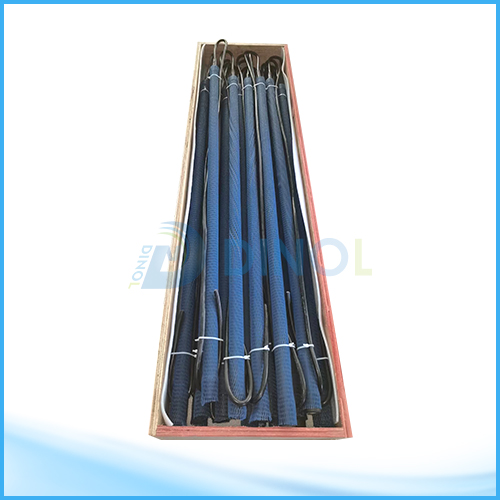
Understanding Canister Anodes and Their Core Materials
A canister anode is a deep well anode device that is already put together in the factory and is used for impressed current cathodic protection (ICCP). It's not the same as simple spare anodes because it needs an outside DC power source to work. This lets the current be precisely controlled over long service times.
What Goes Inside a Canister Anode?
A gas exit line, carbonaceous backfill packed around the anode string, and a galvanized steel case are some of the things that are usually in the assembly. Each element has a specific job to do in terms of electrochemistry or structure. The system comes pre-packaged, so when it gets to the job site it is ready to be lowered into a drilled well. There is no need to mix backfill in the field or splice cables together on the spot.
How It Differs From Traditional Anode Systems?
Anodes made of high-silicon cast iron or graphite were used in older deep well systems. Both materials corrode at rate that can be measured, need to be replaced every so often, and give off inconsistent currents when the soil conditions change. MMO titanium systems work at rates of consumption below 1 mg/A·year in normal conditions, which makes them much more lasting options for projects that are meant to last 20 to 50 years.
Why Material Choice Defines System Performance?
The canister anode for cathodic protection relies on a titanium base that doesn't dissolve anodically, so its shape stays the same over the course of its useful life. The electrochemical process is driven by the catalytic surface of the MMO material, which is usually iridium-tantalum or ruthenium-iridium. The makeup of the coating directly affects how well it flows current, how much power it needs, and how long it lasts.
Key Materials and Their Benefits for Corrosion Protection
How well a deep well anode system works in different types of dirt, temperatures, and structures depends on the materials that are used. The papers that follow each deal with a different type of application.
Here is a list of the main anode materials that engineers come across when they are buying ICCP:
- MMO-Coated Titanium (Ru-Ir or Ir-Ta): The preferred choice for impressed current deep well systems. Grade 1 pure titanium substrate (99.99% Ti, per ASTM B338) provides corrosion immunity. The MMO coating supports current densities up to 100 A/m² in soil environments. Coatings of 8–15 g/m² yield design lives ranging from 20 to 70 years depending on output level and coating formulation.
- Magnesium: Used in sacrificial (galvanic) systems for soil and freshwater pipelines. Magnesium offers a high driving potential (~1.75 V vs. Cu/CuSO₄) but consumes rapidly—typical consumption rate is roughly 7.9 kg/A·year. This limits its role to low-current density applications where no power supply is available.
- Zinc: Preferred for marine and brackish water environments. Zinc delivers a stable output (~1.05 V vs. Cu/CuSO₄) and resists passivation in chloride-rich electrolytes. It is less suitable for high-resistivity soil due to low driving potential.
- Graphite/High-Silicon Cast Iron: Legacy materials still present in older systems. Both are more brittle than titanium, prone to mechanical damage during installation, and corrode at rates that require system redesign within 15–20 years.
Material Selection Criteria for Canister Anodes in B2B Procurement
Before a buy order is made, engineers have to look at a number of measurable site and system factors to choose the right anode material.
Soil Resistivity and Environmental Conditions
The anode ground resistance and, by extension, the number of anode wells needed to reach the target protection current are both based on the resistivity of the soil. It works best to put in deep wells and low-resistivity carbonaceous backfill at sites with resistivity above 50 ©·m. This lowers ground resistance and moves the main anode reaction away from the titanium surface.
Compliance With Recognized Standards
When buying materials for gas pipeline or storage tank projects, procurement teams must make sure that the canister anode for cathodic protection meets the requirements of NACE SP0572, NACE SP0193, EN 12954, and GB/T 50934, as needed. That is ASTM B338 Grade 1 or 2 for titanium substrates used in MMO anodes. The four types of cable insulation—PVDF, HMWPE, HALAR, and XLPE—must be matched to the chlorine gas environment at the anode surface while the system is running.
Lifespan and Output Stability
A protection goal of 30 years means that the anode material has to keep putting out the same amount of current without getting much worse. This is possible with MMO coatings because they are electrochemically stable. At normal working voltages, the coating doesn't dissolve and the titanium base doesn't passivate. In line with NACE TM0108 standards, suppliers must give accelerated life test data and certificate of conformance (CoC) paperwork for every production batch.
Comparing Canister Anode Materials: Procurement and Application Insights
When procurement teams compare deep well anode options for pipeline networks or tank bottom protection, the differences between material classes become financially significant at project scale.
MMO Titanium vs. High-Silicon Cast Iron
High-silicon cast iron anodes consume at approximately 0.25–1.0 kg/A·year. For a 30-year design life at moderate current output, this consumption rate requires either oversized initial installations or scheduled replacement. MMO titanium anodes consume at under 1 mg/A·year—roughly 1,000 times slower. This difference justifies the higher unit cost on any project where access for replacement is difficult or expensive.
Factory-Prepackaged vs. Field-Assembled Systems
Field assembly of deep well anode beds introduces variability in backfill density, cable splice integrity, and gas vent placement. A factory-prepackaged canister anode system eliminates these variables. The Tianyi MMO canister anode arrives as a complete cylindrical assembly—anode string, calcined petroleum coke backfill, gas vent pipe, and galvanized steel casing—ready for direct installation. Construction time at the well site drops significantly, and quality control is maintained under factory conditions rather than field conditions.
Cable and Connection Integrity
The cable-to-anode connection is the most statistically common failure point in ICCP deep well systems. Insulation materials must resist chlorine gas produced at the anode surface. PVDF and HMWPE are the two most field-tested options for this application. Connections sealed to IP68 rating prevent water ingress at depths exceeding 20 meters, which is where most deep well anodes operate.
Installation, Maintenance, and Troubleshooting of Canister Anode Materials
Installation Depth and Backfill Placement
Deep well anodes are put in vertically at depths greater than 20 meters. This puts the point where the current flows far away from the building that is being secured. This shape spreads the current more evenly along the pipeline segments and lowers the interference with metal structures next to them. Around the anode string, carbonaceous backfill, ideally calcined petroleum coke, is packed at a density that keeps the contact resistance low over time and prevents gas pockets. This is a common configuration for a canister anode for cathodic protection in deep well groundbeds.
Monitoring and Maintenance Intervals
Once they are set up, MMO deep well anode systems don't need much regular maintenance. Checks that should be done regularly include measuring the pipe-to-soil potential at test points once a year, making sure that the rectifier output is correct, and measuring the resistance to earth on a regular basis. If the ground resistance changes more than 20% from the starting point, it's likely that the backfill is settling, gas is getting blocked, or the cable is damaged.
Diagnosing and Correcting Failure Modes
If the output current drops without any changes to the rectifier settings, it's most likely due to anode passivation (which doesn't happen often with MMO but could happen if the operating voltage goes above the titanium breakdown threshold of about 8–10 V in chloride environments), a failure in the cable insulation, or backfill compaction that blocks the gas vent. Each of these failure modes has its own unique electrical signature that can be found using standard DCVG or CIPS survey methods by a trained corrosion engineer.
Conclusion
Material choice is an important part of deep well canister anode systems because it affects how long the system lasts, how much upkeep it needs, and how much it costs all together over a 20–50 year security period. The most stable performance profile for ICCP uses in pipes, storage tanks, and port structures is achieved by canister anode for cathodic protection using MMO-coated titanium anodes, calcined petroleum coke backfill, and chlorine-resistant cable insulation. Factory-prepackaged formats protect building quality and lower the number of different ways that a job can be done. When engineers select these materials based on ASTM B338, NACE SP0572, or EN 12954, they give their projects the best chance of long-term rust protection.
FAQ
Can MMO canister anodes be used in high-resistivity soil?
Yes. When used with calcined petroleum coke backfill, the deep well installation method greatly lowers ground resistance. This means that MMO canister anodes can be used even in soils with resistivity higher than 100 ©·m. Before the design is finalized, soil resistivity testing is done to set the well count and depth.
What cable insulation should I specify for a deep well anode?
Most people choose PVDF or HMWPE because they can both fight chlorine gas that is made at the anode surface. When chemical exposure patterns are different, HALAR and KYNAR are good options.
Do factory-prepackaged systems meet standard project specifications?
For the titanium substrate, Tianyi's canister anodes meet ASTM B338 Grade 1 or 2. They can also be sent with documentation covering EN 12954, NACE SP0572, and GB/T 50934 alignment for design institute approval workflows.
What is the minimum order quantity?
Tianyi lets you set up phased delivery schedules of up to 12 months for big pipeline or storage tank projects, and the minimum order number is one unit.
Request a Technical Proposal From Tianyi — Your Trusted Canister Anode for Cathodic Protection Supplier
At our Baoji plant, Tianyi makes MMO canister anodes that are already packaged and come with full CoC paperwork, custom sizing, and standard compliance packages for design institute approval. Our engineering team is ready to help you with your specifications from the first soil resistivity test to the final installation, whether you need a single prototype unit or deliveries spread out over 12 months. You can email us at info@di-nol.comto get a detailed document or a quote that is tailored to your project.
References
1.NACE International. Cathodic Protection of Underground Storage Tank Systems(NACE SP0285). NACE International, 2011.
2.Peabody, A. W. Control of Pipeline Corrosion, 2nd ed. NACE International, 2001.
3.von Baeckmann, W., Schwenk, W., & Prinz, W. Handbook of Cathodic Corrosion Protection, 3rd ed. Gulf Professional Publishing, 1997.
4.British Standards Institution. Cathodic Protection of Buried or Immersed Metallic Structures — General Principles and Application for Pipelines(EN 12954). BSI, 2001.
5.ASTM International. Standard Specification for Seamless and Welded Titanium and Titanium Alloy Tubes for Condensers and Heat Exchangers(ASTM B338). ASTM International, 2021.
6.Gummow, R. A., & Wakelin, R. G. "Cathodic Protection of Deep Well Vertical Anode Groundbeds." Materials Performance, NACE International, 1995.